Should you build an extension or move house?
Extensions offer more affordable choices than moving.
ICF is self-build friendly and can be used when access is restricted.
Extending existing properties requires careful consideration.
Seamlessly Connect Your New Extension to Any Existing Home.
To move or build a house extension?
Pros & Cons To House Extensions
Building onto your current property allows you to stay in an area you love while tailoring a space, like a modern kitchen or a high-tech home office, exactly to your needs.
Pros & Cons To Moving House
Moving can provide an immediate upgrade in location or school catchment area that no amount of construction can fix. And when buying and selling a house is now such a costly and difficult process, many people are considering an extension as an alternative.
The Advantages of Using ICF for House Extensions
Building a house extension is a significant investment, and choosing the right construction method is vital for both cost and performance. One of the most efficient modern methods of construction is Insulating Concrete Forms (ICF).
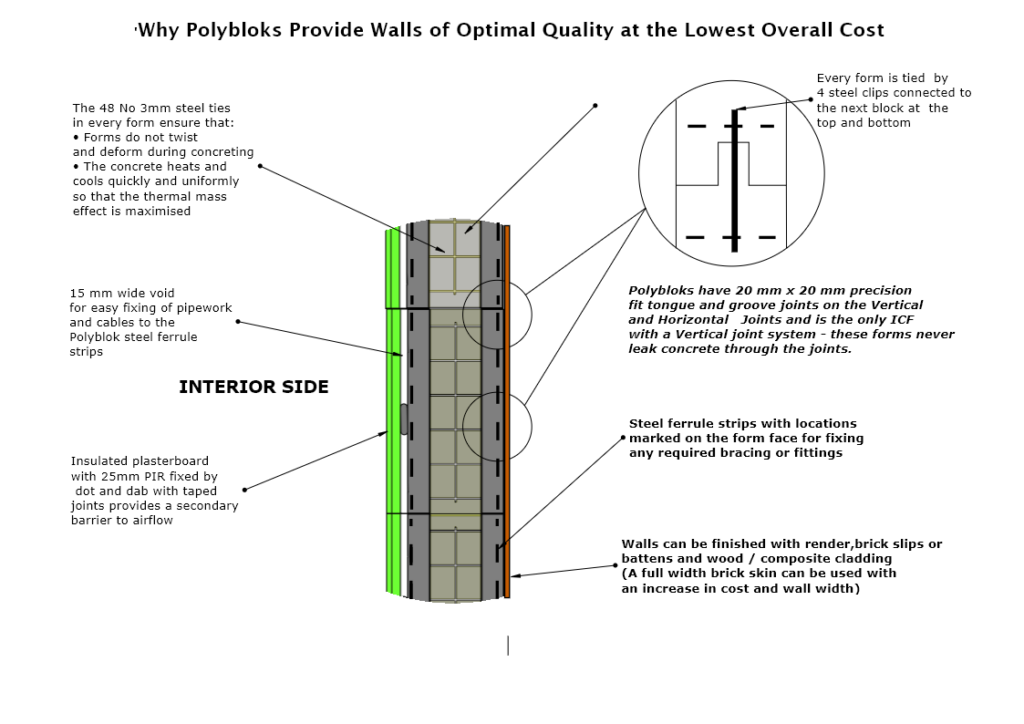
The primary advantage of using ICF for extensions is that it is “self-build” friendly. Unlike traditional methods, you don’t necessarily need highly skilled bricklayers to lay heavy blocks or bricks.
Key Benefits for Your Home Extension
Beyond the ease of construction, ICF offers several technical and financial advantages for those extending their homes:
Protect your investment from the elements. Speak to our experts to ensure your shell is wind and weathertight—built right, on budget, the first time.
Planning Your House Extension
Many homeowners mistakenly believe the design of house extensions is a straightforward process. In reality, connecting a new structure to an existing building requires deep structural knowledge. You must understand how the type (and condition) of the existing structure constrains the new build.
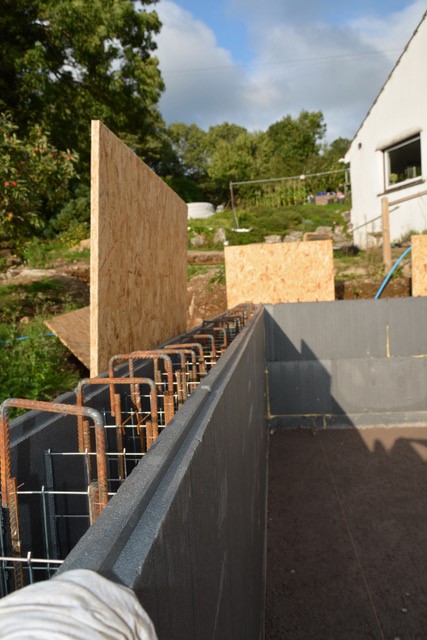
With ICF, integrating an extension to your existing property is simplified. For instance, you can attach new walls to existing cavity walls by fixing galvanised ties to the brickwork that protrude into the ICF cavity, creating a permanent, rigid fixing once the concrete is poured. Furthermore, the foundations for an ICF extension can be a simple 150mm flat slab with edge thickenings extending below the frost line (500mm), reducing the complexity of groundworks.
While Permitted Development rules often allow for detached extensions in a rear garden, these “garden rooms” may lack the seamless access required for daily family life. Furthermore, a layout that works now might fail once an extension is added; for example, adding a ground-floor bedroom for a teenager may create noise conflicts with the living room that a first-floor extension would have avoided.
So many extensions are built that simply do not work because the future use the extension has not been thought through in detail.
Technical Challenges: Underpinning & Foundations
Structural complications often arise when foundation excavations for the new build are deeper than those of the existing house. This is common with pre-war housing featuring shallow foundations. If your new foundations are near or shared with a neighbour, you must navigate the legalities of the Party Wall etc. Act 1996.
Party Wall Agreements
A Party Wall Agreement is a legally binding document required in England and Wales when work affects a shared boundary or requires excavation within 3–6 meters of a neighbour’s structure.
The Rise of Garden Buildings
Another popular method to extend the indoor space of your property is to build a bespoke garden house. The construction process can be very straightforward when an ancillary building can be placed in the garden away from boundaries (subject to height restrictions). Especially if there is access for material delivery and export of the excavation arisings.
However, you must still provide planning quality drawings to the Local Authority to obtain a Lawful Development Certificate, confirming whether the project falls under Permitted Development.
Using ICF For Garden Buildings & Studios
ICF is equally effective for detached garden buildings, offering the same rapid construction benefits. It is particularly popular for home music studios due to the exceptional soundproofing qualities that ICF Polybloks provide.
When building an ancillary garden room away from boundaries, you can often take advantage of Permitted Development rules. This makes the design and construction straightforward, especially if there is clear access for material delivery and soil removal.
Note on Planning: Even if your project falls under Permitted Development, you should provide planning-quality drawings. Obtaining a Lawful Development Certificate from your Local Authority is highly recommended to confirm your project is legal and to avoid issues when selling your property in the future.
Conclusion
Whether you are looking to add a single-story sunroom or a complex multi-level addition, well-planned house extensions offer a bespoke alternative to the volatile 2026 housing market. By avoiding the sunk costs of moving and focusing on high-quality design, you can transform your current property into your dream home. If you are ready to increase your square footage and property value, start by consulting with a structural engineer to ensure your house extensions are built on a solid legal and physical foundation.